

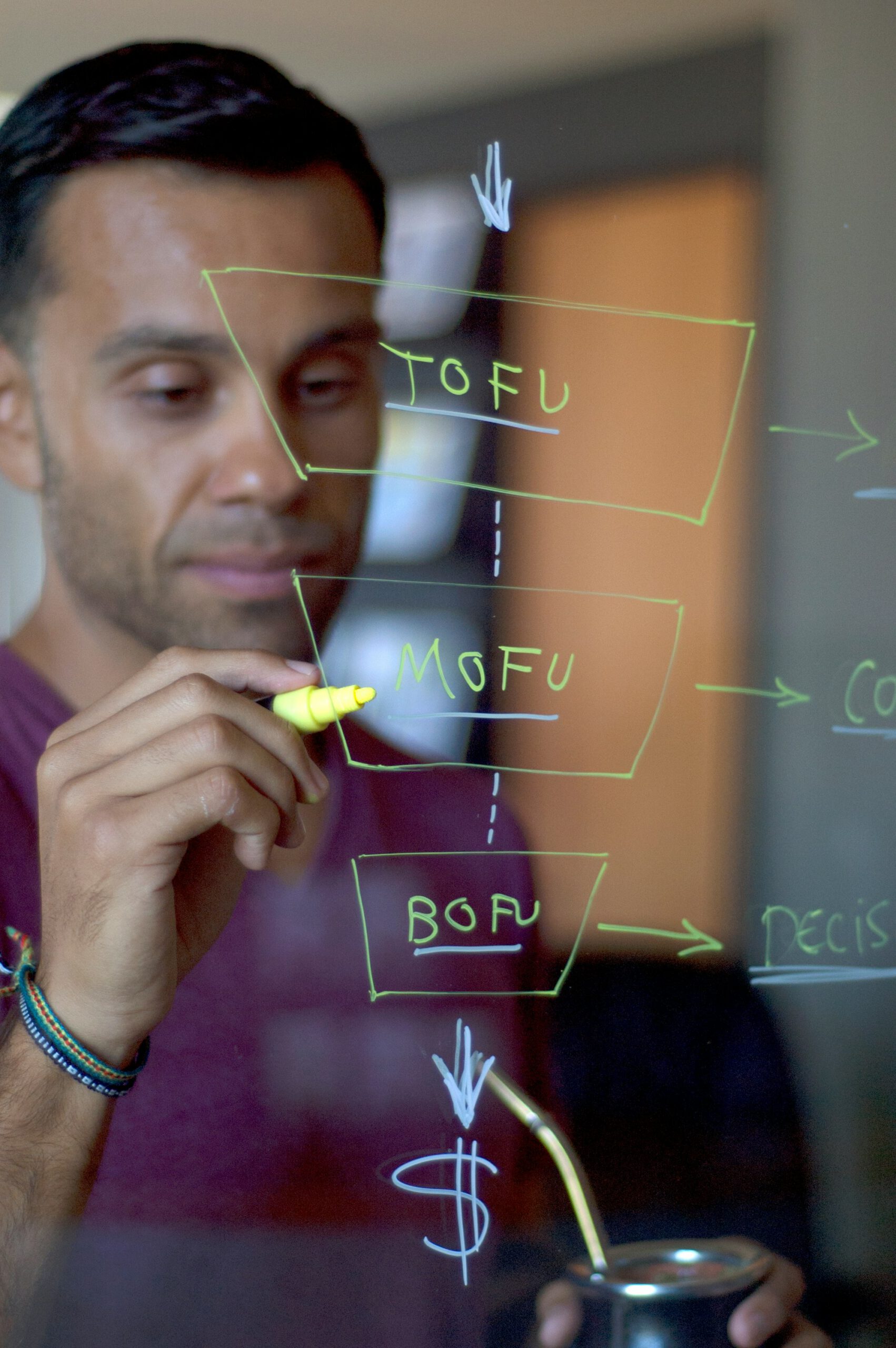
How D2C Brands Turn Customers Into a Growth Engine
Most brands still run growth like this: spend money, get a customer, spend money again. It’s called a funnel, and it works — until you look at what happens to the customer after they buy.
Nothing. The funnel ends. The customer becomes a line item, not an asset.
That’s the mistake. In D2C, the purchase isn’t the finish line — it’s the handoff. What a customer does after buying can be worth more than what it took to acquire them in the first place. They reorder. They leave a review. They post a story. They tell a friend. Each of those actions quietly feeds a new customer back into the top of the funnel — for free.
When you connect that loop deliberately instead of hoping it happens, you get a Funnelwheel: a funnel that feeds a flywheel, and a flywheel that feeds the funnel back.
Funnel vs. Flywheel — the two engines
The funnel is a conversion machine. It answers: how does a stranger become a buyer?
Awareness → Consideration → Purchase
You measure it with reach, CTR, conversion rate, CAC, AOV. It’s excellent at diagnosing where people fall off before they buy.
The flywheel asks a different question: what happens after someone buys?
Experience → Retention → Advocacy → New Awareness
Its job isn’t conversion. It’s compounding. A good flywheel means the 1,000th customer was cheaper to acquire than the 100th — because the first 100 are doing some of the marketing for you.
A Funnelwheel is what you get when you stop treating these as two separate systems and start engineering the point where they connect.
   AWARENESS → CONSIDERATION → PURCHASE
                                   ↓
                              EXPERIENCE
                                   ↓
                              RETENTION
                                   ↓
                              ADVOCACY
                              ↙        ↘
                      REFERRALS      UGC/REVIEWS
                              ↘        ↙
                            AWARENESS (again)
The bottom arrow is the entire idea. Advocacy doesn’t dead-end — it re-enters at the top. That’s the difference between a funnel and a wheel.
Why the funnel alone runs out of road
Say a brand spends ₹10L a month on ads and lands 10,000 customers. Next month, if it wants another 10,000, it has to buy another 10,000 — from scratch. The customer from last month is only worth something to next month’s growth if the brand deliberately gave them a reason to talk, share, or return.
So the real question changes. Not “how much can we spend to acquire customers,” but:
What does every customer do for the next customer?
That reframe changes what you build. Instead of only optimizing ad creative, you start optimizing unboxing, onboarding, and the moment someone decides whether this is worth mentioning to a friend.
Walking the wheel: a fashion brand example
Awareness — A creator posts “I tested 5 premium T-shirts under ₹1,500.” Your brand is in it. Someone notices.
Consideration — They land on the product page: fabric details, size guide, real reviews, UGC. Their question shifts from “what is this” to “is this right for me.”
Purchase — They buy two shirts. The funnel’s job is technically done. The Funnelwheel’s job just started.
Experience — The package shows up looking good, the fit is right, the fabric feels better than the price suggested. This single moment decides everything downstream.
Retention — A useful email a few weeks later (“how to make your tee last longer”), a new-colors drop — and they buy again. LTV moves.
Advocacy — They wear it on a trip. A friend asks where it’s from — that’s a referral, unprompted and free. They post a story — that’s UGC. They leave five stars — that’s proof for the next stranger evaluating the brand.
Back to Awareness — With permission, the brand reuses that UGC in an ad. A new prospect sees a real customer, not a studio shot, wearing the product. They enter the funnel. The wheel turns again.
The same mechanic plays out differently across categories — a coffee brand turning a brewing guide into repeat orders and unboxing videos, a beauty brand turning a “get ready with me” clip into a discovery channel, a kitchen brand turning a recipe into the actual acquisition asset. The categories change; the mechanism doesn’t.
The moment that decides everything: Experience
This is the part most D2C brands underinvest in, because it doesn’t show up in an ads dashboard.
The customer never sees your funnel. They see the box, the unboxing, the instructions (or lack of them), the support reply, whether the product actually does what the landing page promised. That’s it. That’s the whole brand, as far as they’re concerned.
Two versions of the same coffee subscription:
- Late delivery, damaged bag, no brewing guide → the customer probably never becomes an advocate, no matter how good the ad was that acquired them.
- On-time, well-packaged, a one-page brewing guide, a short “here’s how to make your first cup” email → the odds of a second order, a review, or a recommendation jump materially.
Same acquisition spend. Very different downstream value. Experience is the bridge between the funnel and the flywheel — get it wrong and the wheel never starts turning.
Advocacy splits into two different jobs
Once a customer is happy, advocacy shows up two ways, and they’re not interchangeable:
Referrals are one-to-one. A customer tells a specific person they know. High trust, low reach.
UGC and reviews are one-to-many. A review or a Reel doesn’t introduce one person — it becomes a standing asset that influences hundreds of strangers evaluating the brand cold. It’s also the raw material your funnel can reuse directly: in ads, on product pages, in retargeting.
This is the real unlock: the flywheel doesn’t just generate new customers, it makes the funnel itself perform better. More reviews lower perceived risk. Real UGC outperforms studio creative. The two systems aren’t just connected — they improve each other.
Ad → Customer → Great Experience → UGC → Better Ad Creative
  → Higher Engagement → More Customers → More UGC → Better Ads
That’s not a funnel anymore. It’s a feedback loop that gets cheaper to run the longer it spins.
Three loops running inside a mature Funnelwheel
- Retention loop —
Purchase → Experience → Repeat purchase → Higher LTV. Makes existing customers worth more. - Social proof loop —
Purchase → Review/UGC → Higher conversion → More purchases. Makes the funnel itself more efficient. - Referral loop —
Happy customer → Referral → New customer → Happy customer. Generates new customers without new ad spend.
Run all three at once and CAC starts declining as a percentage of revenue, even with flat or rising ad spend — because a growing share of new customers are arriving partly on the strength of the old ones.
What to actually measure
A funnel-only dashboard stops at CAC and conversion rate. A Funnelwheel dashboard adds the back half:
| Stage | Key question | Example metrics |
|---|---|---|
| Awareness | Are people discovering us? | Reach, impressions, CTR |
| Consideration | Are they evaluating us? | Sessions, add-to-cart |
| Purchase | Are they converting? | CVR, CAC, AOV |
| Experience | Are we delivering the promise? | CSAT, support tickets, returns |
| Retention | Do they come back? | Repeat rate, LTV |
| Advocacy | Are they talking about us? | Reviews, UGC volume, referral rate |
| Re-entry | Is advocacy generating demand? | Referral sales, organic traffic, UGC-assisted CVR |
The number that matters most isn’t any single row — it’s whether Row 7 is feeding back into Row 1.
Building one, without a loyalty-program budget
- Fix the funnel first. Know who buys, why, and where they drop off before you build anything downstream of purchase.
- Engineer the experience deliberately. Packaging, instructions, first-use — ask what would make a customer genuinely glad they bought, not just satisfied.
- Design the second purchase. Don’t wait for retention to happen — know when the customer will next need you, and be there.
- Create something worth sharing. The best UGC isn’t begged for. It comes from a moment the customer actually wanted to talk about.
- Lower the friction on advocacy. A simple “how was it?”, “show us how you use it,” “know someone who’d love this?” — asked at the right moment.
- Put the output back into the input. This is where most brands quietly fail — they collect reviews and UGC and let it sit unused instead of feeding it straight back into ads, product pages, and email.
The one rule underneath all of this
Every stage should make the next one easier.
Awareness should make consideration easier. Consideration should make purchase easier. Purchase should lead somewhere good. That good experience should make retention easier. Retention should produce advocacy. And advocacy should make the next cycle of awareness cheaper than the last one.
A funnel is linear — it has a customer as its output. A Funnelwheel is circular — the customer is the input to the next cycle.
The brands winning in D2C right now aren’t the ones spending the most on ads. They’re the ones who figured out how to make every acquired customer generate part of the next one — turning a cost center into a compounding asset, one purchase at a time.
Leave a Reply