

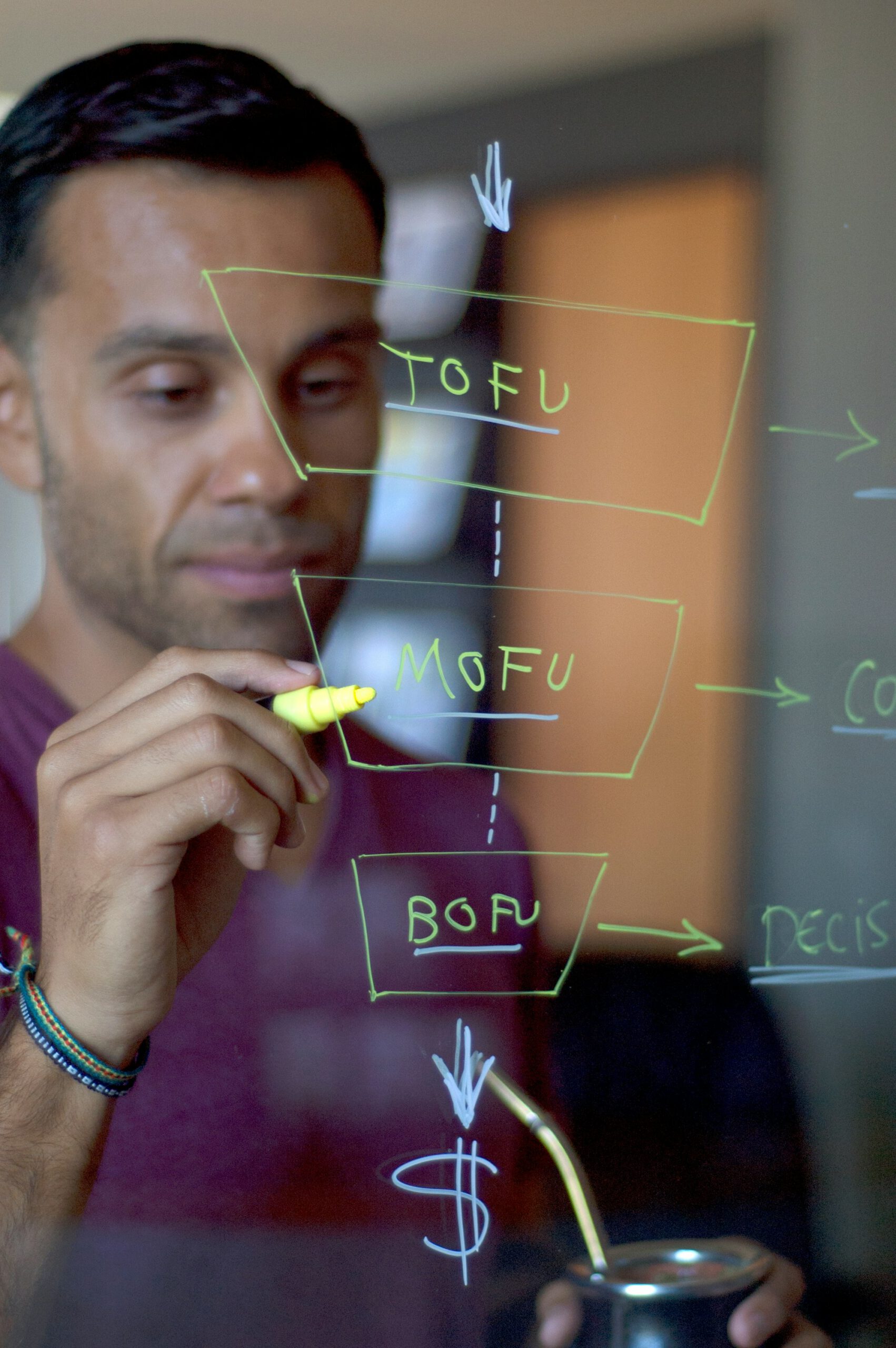
Nobody stumbles onto a website and buys something five seconds later. Not really. Most people find you through a Google search, an ad they half-noticed, a blog post a friend shared, or a social post they scrolled past twice before clicking. They poke around, compare you to a couple of competitors, maybe leave and come back a few days later — and then, if everything lines up, they buy.
A sales funnel is just a way of mapping that messy process into something you can actually work with.
It gives you a framework for moving people from “never heard of you” to some kind of meaningful action — filling out a form, booking a call, starting a trial, checking out.
This guide walks through what a funnel actually is, the stages most businesses go through, a couple of real-world examples, and how to build one without overcomplicating your life.
So What Is a Sales Funnel, Really?
It’s a model of the journey someone takes from first hearing about your business to becoming a paying customer.
The “funnel” part of the name comes from the shape of it: lots of people pour in at the top, and only a fraction make it out the bottom as customers. A basic version looks like this:
Awareness → Interest → Consideration → Decision → Purchase
Picture a company selling accounting software:
- 10,000 people discover them through search, ads, or social media
- 2,000 actually visit the site
- 500 look at the product and pricing
- 100 sign up for a trial or book a demo
- 30 become paying customers
The numbers will look completely different for your business, but the shape of the story is the same — people drop off at every stage, and that’s normal.
Why Bother Thinking in Funnels at All?
Having a website and running some ads doesn’t automatically give you a predictable stream of customers. A funnel helps you understand what’s actually happening between “got their attention” and “earned their business.”
Without one, you might know you had 10,000 visitors last month and only 50 became customers — but you’d have no idea why. With a funnel, you can break that gap down and ask sharper questions: Are enough people finding you in the first place? Are they interested once they land on your site? Are they hitting the pages that actually matter? Are the right leads getting followed up on, and where exactly are people bailing?
That’s a lot more useful than shrugging and guessing why sales went up or down.
The Stages of a Sales Funnel
There’s no single official funnel every business is required to use. Some companies work with four stages, others stretch it to six or more — it really depends on your product, your customers, and how long your sales cycle tends to run.
For most businesses, though, five stages cover it well enough.
1. Awareness
This is where someone first learns you exist — or first realizes they have a problem worth solving. It might happen through a Google search, a YouTube video, an ad, a referral, a podcast mention, or plain old word of mouth.
At this point, they’re usually not ready to buy anything. Someone searching “how do I get more customers for my small business” isn’t shopping for software yet — they’re still trying to understand their own problem. So content at this stage should teach and inform rather than sell. Blog posts, guides, videos, and useful social content all earn their keep here.
2. Interest
Once someone’s aware of you, they might start poking around — reading more articles, browsing your site, watching a product video, following you on social, downloading a resource, or just coming back a second time.
You’re not trying to close anything yet. You’re giving them a reason to keep learning. If someone finds FunnelWheel through an article on sales funnels, the natural next step is understanding how landing pages, lead generation, and conversion optimization fit together.
3. Consideration
Now they’re evaluating. This is where the questions get specific: Is this actually right for me? What does it cost? How does it stack up against the alternatives? Can I trust this company? Will it solve my particular problem, and how hard is it to get up and running?
Detailed product pages, case studies, testimonials, comparisons, and solid FAQs do the heavy lifting here. Your job is to reduce their uncertainty, not add to it.
4. Decision
At this point, they’re seriously considering acting — requesting a quote, booking a demo, starting a free trial, or adding something to a cart. This is where your call to action really earns its place.
A vague “Learn More” doesn’t do much. “Start Your Free Trial,” “Book a Free Consultation,” or “Build Your First Funnel” tells them exactly what happens next. Which one works best depends entirely on what you’re selling and how ready that visitor already is.
5. Purchase
They buy. But this isn’t really the end of the story — a customer can turn into a repeat buyer, a subscriber, a referral source, or someone who eventually buys more from you. Plenty of modern customer-journey thinking treats the purchase as the middle of the relationship, not the finish line.
A Simple Funnel Example: Local Web Design Business
Say a local web design company wants more clients. Their funnel might look something like:
Google search → educational blog post → landing page → free website audit → lead form → email follow-up → consultation → proposal → new client
Each step is doing something specific. The search brings them in. The blog post is useful on its own. The landing page makes a clear offer. The free audit gives them a reason to hand over their contact info. The follow-up keeps things warm. The consultation uncovers what they actually need, the proposal lays out the solution, and finally — a client.
Another Example: An Online Store
Ecommerce funnels tend to be shorter:
Ads or social → product page → add to cart → checkout → purchase
Even a funnel this simple has plenty of places for people to drop off:
- 20,000 people see an ad
- 2,000 visit the site
- 500 view a product
- 100 add it to their cart
- 60 actually check out
If you only ever look at that final number — 60 purchases — you’ll never know where the real problem is. Measuring each stage tells you where fixing something would actually move the needle.
What Counts as a “Conversion”?
A conversion is just whatever action you’ve decided matters — completing your funnel’s goal. That’s not always a sale. It could be filling out a form, booking a meeting, signing up for a newsletter, starting a trial, downloading something, or requesting a quote.
Define what conversion means for your business before you start obsessing over the metric. For one company it’s a phone call; for another, a completed checkout.
Why People Drop Out of a Funnel
Not everyone who enters your funnel is going to buy, and that’s fine. People leave because the price feels too high, they get distracted, their questions never got answered, the checkout process was a pain, or they simply need more time.
The point isn’t to force every single person through to the end. It’s to figure out why the qualified people aren’t moving forward. A healthy funnel isn’t one where everybody converts — it’s one where the right people can move through it without friction.
Building a Funnel Without Overcomplicating It
You don’t need a dozen marketing tools to get started. Just work through the fundamentals.
Know your customer first. Before you build a single page, get specific about who you’re targeting — what problem they have, what they’re currently doing about it, what frustrates them, and what might stop them from buying.
Decide on the goal. Generating leads and selling a product directly call for different funnels. Get clear on which one you’re actually building.
Create an offer worth taking. A free consultation, a discount, a downloadable guide, a demo — something that connects directly to the problem your customer has.
Build a landing page that makes the next step obvious. It should answer: what is this, who’s it for, what problem does it solve, why should I trust you, and what do I do now? Don’t drown people in five competing calls to action.
Capture the lead without overreaching. Name, email, maybe one qualifying question. Every extra field you add is friction you’re choosing to introduce.
Follow up. Giving you an email address isn’t the same as being ready to buy. Email sequences, retargeting, a well-timed call — these all move people along.
Measure it. Visitors, leads, qualified leads, calls booked, customers, cost per lead. Then look for the biggest drop-off and start there. If your landing page only converts 1% of visitors into leads, that’s probably where to focus first — not everywhere at once.
Don’t Try to Fix Everything at Once
This is where a lot of businesses trip themselves up — changing the whole funnel simultaneously instead of finding the one weak link.
Say your funnel looks like this: 10,000 visitors → 800 leads → 300 qualified leads → 20 customers. Your traffic isn’t the problem. Your lead gen isn’t really the problem either. The real opportunity is what’s happening between “qualified lead” and “customer.” On the flip side, if you’ve got plenty of traffic but almost nobody converts to a lead, that’s a sign your landing page or offer needs attention, not your ad spend.
Common Funnel Mistakes Worth Avoiding
Sending everyone to your homepage instead of a focused landing page dilutes your message — your homepage has to serve too many purposes at once. Piling on too many calls to action means none of them stand out. Talking mostly about your company instead of the customer’s problem loses people fast. And building ten pages and fifteen automated emails before you’ve proven the basics work is a great way to burn a lot of time solving problems you don’t have yet. Start simple, and only add complexity once the data tells you it’s needed. Also — don’t skip follow-up. Someone who isn’t ready today might be ready next month, and without a nudge, that person just disappears.
Sales Funnel vs. Marketing Funnel
People use these terms almost interchangeably, but they emphasize different halves of the same journey. Marketing tends to own the earlier stages — attracting attention, building awareness, generating interest. Sales tends to take over from qualified opportunity through to close. In practice, they’re two ends of the same rope, and businesses that treat them as one connected system usually outperform the ones that keep them siloed.
Do You Actually Need One?
If your business relies on generating leads or sales with any consistency, you already have some version of a funnel — whether or not you’ve ever called it that.
Instagram → website → contact form → phone call → customer. That’s a funnel.
Google → blog → product page → checkout → customer. Also a funnel.
The real question isn’t whether you have one. It’s whether you actually understand how it works.
More Traffic Isn’t the Whole Answer
More visitors sounds like a win on paper, but traffic alone doesn’t grow a business. Compare two sites: one gets 100,000 visitors and lands 500 customers; another gets a fifth of the traffic — 20,000 visitors — and lands 600 customers. The smaller site is winning, because it’s converting better at every stage, not just attracting more eyeballs.
That’s the real argument for thinking in terms of the whole journey — traffic, engagement, leads, opportunities, customers — instead of chasing one number in isolation.
Build It Around the Customer, Not the Tools
The best funnels aren’t built around whatever software a business happens to like. They’re built around the actual customer journey. Start by asking what your customer knows the moment they first find you, what they need to understand before they’ll even consider your solution, what would make them comfortable enough to act, and what makes the whole process feel easy and trustworthy rather than like a sales trap.
Answer those honestly, and the shape of your funnel tends to fall into place on its own.
Final Thoughts
A sales funnel is really just a framework for understanding how people go from not knowing you exist to becoming a customer. The exact shape will differ — a small ecommerce store might have a short, quick funnel, while a B2B company selling an expensive service could have a buying process that stretches for months.
What matters is understanding the journey: get specific about your customer, define a real goal, build an offer worth taking, keep the path to conversion simple, follow up with the people who show interest, and measure what’s happening at each stage along the way.
And don’t treat it as something you build once and forget. The best funnels get better over time, as you learn more about how your customers actually behave — not how you assumed they would.
Leave a Reply