

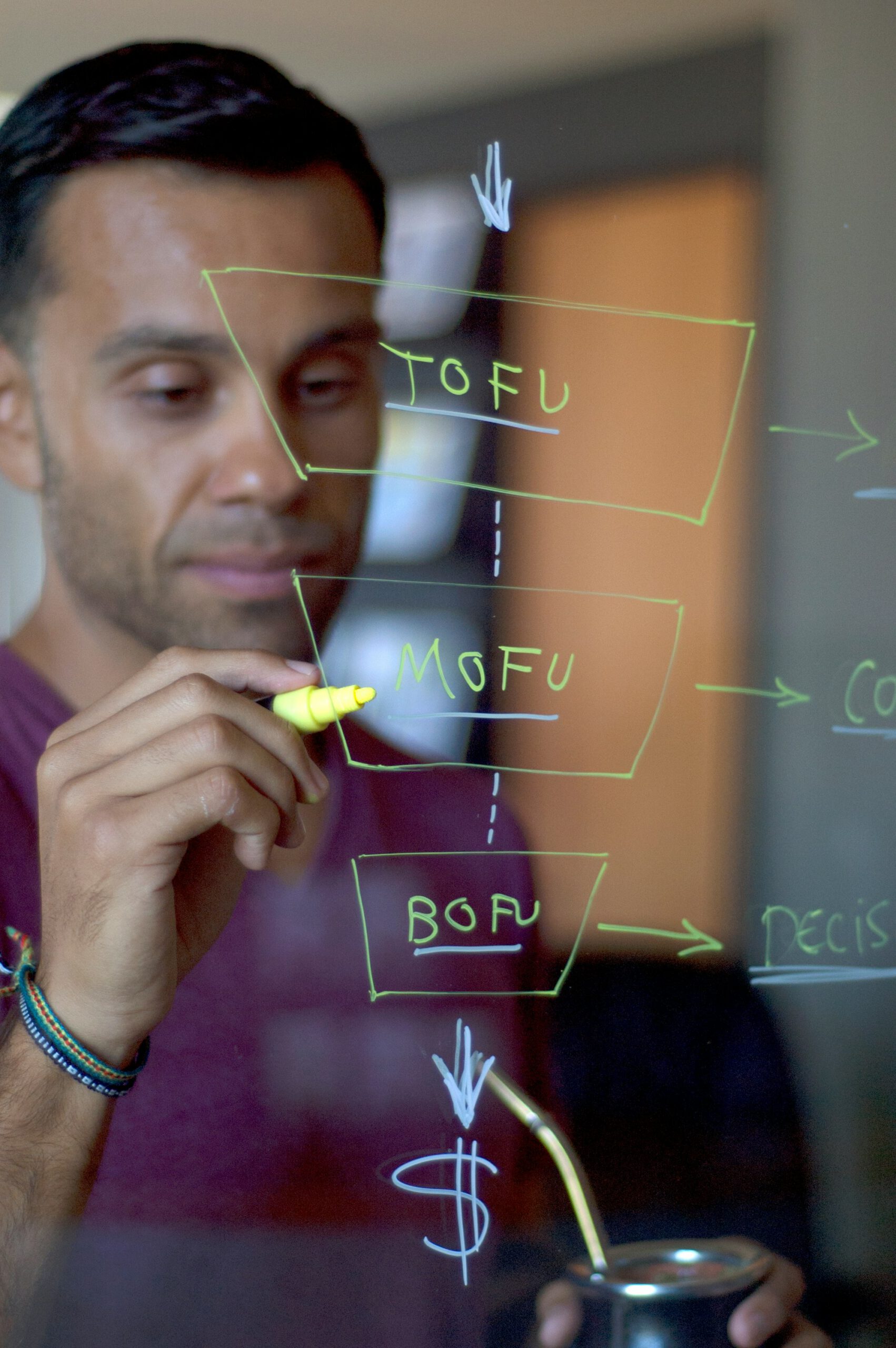
From VSLs to offer ads: what to run at the top, middle, and bottom of the funnel, and how to scale what works.
A creative that flops isn’t always a bad creative. Often it’s the right ad shown at the wrong stage of the buyer’s journey.
A stranger scrolling past needs something different from a shopper who has read your reviews and is waiting for a reason to buy. This post gives you three things:
- The creative formats that fit each funnel stage
- A simple rule for testing new creative
- A repeatable way to scale winners
1. Match the format to the funnel stage
| Stage | The viewer is thinking | The ad’s job | Formats to run |
|---|---|---|---|
| Top of funnel | “I don’t know you, or I don’t see the problem.” | Attention, curiosity, recognition | VSL, stitched ads, native image ads, AI animation/Pixar-style ads |
| Middle of funnel | “I know the problem. What and who can I trust?” | Proof, education, comparison | UGC/review ads, editorial ads, comparison image ads |
| Bottom of funnel | “I’m nearly ready. Why now?” | Offer and urgency | Offer image ads, offer video ads on YouTube |
Top of funnel: stop the scroll
Cold viewers don’t need your offer yet. They need a reason to care.
- VSL: a longer video that walks a cold viewer through the problem, the mechanism, and the solution.
- Stitched ads: clips edited together in a native, social-first style, usually a hook, a reaction, and a demonstration.
- Native image ads: static ads that look like organic content or editorial rather than a traditional ad.
- AI animation / Pixar-style ads: stylized animation that makes an abstract problem or mechanism easy to grasp at a glance.
Lead with: a problem, a story, or an idea. Not a discount.
Middle of funnel: build belief
These viewers know the problem and are comparing options. Give them proof and a way to evaluate.
- UGC / review ads: real customers, or creators speaking as customers, describing their experience.
- Editorial ads: educational angles like “What to look for when buying X.”
- Comparison image ads: authority or side-by-side framing like “Doctors recommend these X products.”
Lead with: proof, expertise, and clear buying criteria.
Check your claims. If you use authority framing such as “doctors recommend,” make sure the claim is accurate and can be substantiated, and that it meets platform ad policies and local advertising rules. Unsupported claims get ads rejected and erode trust.
Bottom of funnel: make acting easy
These viewers already know you. Skip the education.
- Offer image ads: a discount, bundle, guarantee, or deadline in a simple static ad.
- Offer video ads on YouTube: short video restating the offer and the key proof points.
Lead with: the offer.
2. A simple testing rule
A new creative should spend at least 1.5x your target CPA over roughly 3 to 4 days before you judge it.
- 1.5x target CPA means the ad has spent more than one acquisition should cost, so a lack of results is meaningful.
- 3 to 4 days smooths out day-to-day noise and gives delivery time to settle.
- One rule for every creative keeps comparisons fair and removes gut-feel decisions.
Adjust the numbers to your margins and conversion volume, but set the rule before you launch and stick to it.
3. Scale winners in two moves
Move 1: Graduate the winner. When a creative clears your testing bar, move it into a dedicated scaling campaign. This keeps your test budget clean and lets you push spend on proven creative without disrupting new tests.
Move 2: Expand the winner. Don’t stop at one ad. Take the winning concept and change one of these variables at a time:
- Offer: a different offer, bundle, or price point
- Funnel: a different destination for the traffic
- Market: a new country or region
- Audience: a different customer avatar
- Other format: the same idea rebuilt as another format
Example: expanding one winner
Say a native image ad performs well with an advertorial landing page. Your expansion path might look like this:
| Step | What changes | What stays the same |
|---|---|---|
| 1 | Send the same creative to a quiz instead of the advertorial | Creative, angle |
| 2 | Turn the same angle into a YouTube VSL | Angle, offer |
| 3 | Try a different customer avatar | Core concept |
| 4 | Build 5 new angles around the same concept | Core concept |
Every variation goes through the same testing process: same spend rule, same timeframe, same bar for a winner.
The advantage is that each new test starts from something that already worked and changes only one thing, so you learn faster and waste less.
4. Where the funnel meets the flywheel
- The funnel matches each format and landing page to where the shopper is in their journey.
- The flywheel turns every winner into the starting point for the next round of tests, and every result into insight about which formats, avatars, and angles work.
Keep ad and landing page in the same conversation. A top-of-funnel ad that opens with a problem should land on a page that resolves it. A bottom-of-funnel offer ad should land somewhere that makes buying easy. When ad and page tell different stories, promising creative stalls.
[I am building FunnelWheel helps WooCommerce stores build the landing pages and offers each funnel stage needs. ]
Quick checklist
Before launch
- Format matches the funnel stage
- Landing page continues the ad’s story
- Target CPA, 1.5x spend threshold, and 3 to 4 day window are set
When a creative wins
- Move it to a dedicated scaling campaign
- Expand across offer, funnel, market, audience, and format
- Put each variation through the same testing process
The takeaway
Don’t just ask, “What’s our best ad?” Ask:
“What’s the right format for this stage, and how does each winner become the next test?”
Match the format to the mindset, test with a clear rule, scale winners separately, and expand them one variable at a time.
Leave a Reply